API Integration Strategy for UK Businesses | Nexteck
Discover how API integration helps UK businesses connect CRM, ERP, finance and operational software, automate workflows, reduce manual data entry and build scalable digital systems.
API integration services UK
API integration strategy, business system integration UK, custom API development UK, software integration services, enterprise API integration, CRM ERP integration, API automation, business process automation UK, cloud API integration, third-party API integration, REST API development, secure API architecture, legacy system integration, digital transformation UK.
API integration UK, API integration services UK, API development company UK, business software integration, enterprise API architecture, custom API development, CRM integration UK, ERP integration UK, finance system integration, cloud integration services, REST API integration, third-party API integration, software automation UK, business process automation, system connectivity, data synchronisation, API security, scalable software architecture, legacy software integration, UK SME technology solutions, enterprise integration strategy, digital transformation consultancy London.
UK SMEs, business owners, operations directors, CTOs, IT managers, finance teams, e-commerce businesses, professional services firms, manufacturers and growing enterprises.
Commercial investigation and service discovery.
London, Manchester, Birmingham, Leeds, Bristol, Glasgow, Edinburgh, Liverpool, Reading, Oxford, Cambridge and across the United Kingdom.
API Integration Strategy for UK Businesses: How to Connect Software, Reduce Manual Work and Build Scalable Operations
Modern businesses rarely operate through a single software platform. A growing UK company may use one application for customer relationship management, another for accounting, a separate e-commerce platform, cloud storage, inventory software and several specialist operational tools.
Each application may work perfectly on its own. The real difficulty begins when these systems need to exchange information.
Customer details are entered more than once. Sales information does not automatically reach finance. Inventory updates are delayed. Employees spend valuable time transferring data between platforms, checking spreadsheets and correcting inconsistent records.
These problems can become increasingly expensive as a business grows.
API integration provides a structured way to connect different software applications so they can exchange information and trigger business processes automatically.
For UK SMEs and larger organisations, a well-planned API integration strategy can improve operational visibility, reduce repetitive administration, strengthen data consistency and create a more flexible technology environment.
However, successful integration involves much more than connecting two applications. Businesses need to consider architecture, security, data ownership, performance, monitoring, scalability and long-term maintenance.
This guide explains how UK businesses can plan API integration projects, identify high-value opportunities and build connected digital operations.
1. What Is API Integration?
An Application Programming Interface, commonly known as an API, allows different software applications to communicate through defined requests and responses.
For example, when a customer places an order through an online store, an API can help transfer relevant information to other systems.
The workflow might look like this:
A customer submits an order.
The e-commerce platform sends order information through an API.
The inventory system checks product availability.
The payment platform processes the transaction.
The finance application receives the transaction details.
The CRM updates the customer's purchase history.
The customer receives an order confirmation.
Without integration, employees may need to complete several of these steps manually.
With an appropriately designed integration, information can move between systems according to predefined rules.
Businesses can explore how connected technology supports different operational environments through Nexteck's industry solutions.
2. Why UK Businesses Need an API Integration Strategy
Many organisations purchase software to solve individual problems. Over time, this creates a collection of disconnected platforms.
A company might have:
CRM software for sales and customer management.
ERP software for business operations.
Accounting software for invoices and financial records.
E-commerce platforms for online transactions.
Warehouse management systems for inventory.
HR software for employee information.
Customer support platforms for service requests.
Reporting applications for management dashboards.
The challenge is that these platforms may not share information automatically.
The hidden cost of disconnected systems
Disconnected software creates operational costs that are not always visible in technology budgets.
Employees may spend hours transferring information, investigating mismatched records and correcting errors.
Managers may also struggle to obtain reliable reports because information is distributed across multiple platforms.
Typical business problems include:
Repeated manual data entry.
Delayed order processing.
Inconsistent customer records.
Duplicate supplier information.
Slow financial reconciliation.
Poor visibility across departments.
Delayed management reporting.
Limited automation opportunities.
Increased dependency on spreadsheets.
API integration can address these problems by establishing controlled communication between business applications.
3. Common API Integration Opportunities for UK SMEs
The most effective integration projects begin with a clearly identified business problem rather than a particular technology.
A. CRM and ERP integration
Sales teams and operations teams often use different platforms.
When CRM and ERP systems are disconnected, employees may need to copy customer information, order details and sales updates manually.
A CRM–ERP integration can help synchronise:
Customer account details.
Sales opportunities.
Confirmed orders.
Product information.
Customer pricing.
Invoice status.
Delivery information.
Account updates.
This creates better visibility between sales, finance and operations.
B. E-commerce and inventory integration
Online retailers need accurate information about stock availability, product details and customer orders.
An integration between e-commerce platforms and inventory software can support:
Automatic stock updates.
Order synchronisation.
Product catalogue updates.
Returns management.
Warehouse notifications.
Delivery status updates.
Sales reporting.
This is particularly valuable for businesses operating across multiple sales channels.
C. Finance and payment integration
Finance departments often work with banking platforms, payment gateways, accounting applications and invoicing systems.
API integration can help transfer transaction information into financial workflows, subject to the capabilities and permissions of each provider.
Potential applications include:
Payment confirmation.
Invoice status updates.
Transaction categorisation.
Refund notifications.
Customer payment records.
Financial reporting.
Reconciliation workflows.
Automated processes still require appropriate validation and exception handling. Businesses should not assume that an API connection automatically guarantees accurate accounting.
D. Supplier and procurement integration
Manufacturers, wholesalers and distributors frequently exchange purchase orders, product information, delivery updates and supplier records.
API integration can help reduce communication delays by connecting procurement applications with ERP, inventory and supplier platforms.
E. Customer support integration
Customer support teams need access to accurate order, account and service information.
Connecting CRM, ticketing, order management and communication platforms can help employees respond with better context.
For businesses reviewing their wider technology requirements, the Nexteck SME strategy approach provides a starting point for understanding operational and architectural priorities.
4. API Integration Architecture: Choosing the Right Approach
Not every business needs the same integration architecture.
The right approach depends on the number of systems, transaction volumes, security requirements, data complexity and future growth plans.
Point-to-point integration
Point-to-point integration directly connects one application with another.
For example:
CRM to accounting software.
E-commerce to inventory software.
Payment gateway to order management.
This approach can work well when there are only a few connections.
However, as the number of applications increases, managing multiple individual connections can become difficult.
Middleware-based integration
Middleware provides a central integration layer between applications.
Instead of connecting every system directly, applications communicate through a shared integration platform or service.
Potential advantages include:
Centralised integration logic.
Easier data transformation.
Better monitoring.
Reusable connections.
Improved system management.
The architecture must still be designed carefully to avoid creating a central dependency that becomes difficult to scale or maintain.
API gateway architecture
An API gateway provides a controlled entry point for API traffic.
It can support authentication, request routing, rate limiting, monitoring and access policies.
This can be useful when businesses expose several internal or external APIs.
Event-driven integration
Event-driven architecture allows systems to react when specific business events occur.
For example:
An order is confirmed.
A payment is received.
A product becomes unavailable.
A customer account is updated.
A delivery status changes.
The relevant event can trigger an action in another application without requiring every system to repeatedly check for updates.
This approach can support more responsive and scalable operations.
5. REST APIs, Webhooks and Real-Time Data Synchronisation
Understanding different communication methods helps businesses select appropriate integration solutions.
REST APIs
REST APIs commonly use HTTP methods such as GET, POST, PUT, PATCH and DELETE to retrieve or modify information.
They are widely used for communication between web applications and business systems.
Webhooks
A webhook sends information to another application when a particular event occurs.
For example, a payment provider might notify an order management system when a transaction succeeds.
This can reduce the need for continuous polling.
Scheduled synchronisation
Some business information does not need to be transferred instantly.
Scheduled synchronisation can update records at defined intervals, such as every 15 minutes, hourly or overnight.
The correct approach depends on business requirements.
A payment confirmation may need near-real-time processing, whereas a management report may only require daily updates.
6. API Security: Protecting Business Data and Systems
Integration increases connectivity, but it also introduces additional security considerations.
Every connection should have a clear purpose, defined permissions and appropriate protection.
Important security practices include:
Authentication and authorisation: Use suitable authentication mechanisms and ensure applications can access only the resources they require.
API keys and secrets: Store credentials securely. Avoid hardcoding sensitive keys into publicly accessible code repositories or client-side applications.
Encryption: Protect data in transit using appropriate transport security.
Rate limiting: Apply limits to reduce abuse, accidental overload and excessive requests.
Input validation: Validate incoming information before processing it.
Logging and monitoring: Record relevant events while avoiding unnecessary exposure of sensitive information.
Access reviews: Regularly review integrations, credentials and third-party permissions.
Incident planning: Define how credentials can be revoked, integrations disabled and affected systems investigated.
UK businesses handling personal information should also consider applicable data protection obligations. The Information Commissioner's Office provides guidance on data protection and security at ico.org.uk.
Security should be incorporated into the architecture from the beginning rather than added after integration has been completed.
7. Data Mapping and Transformation: The Foundation of Reliable Integration
Two applications may store the same business information in completely different formats.
One system might identify a customer using an account number, while another uses an email address.
One application may store dates in one format, while another expects a different structure.
Without proper data mapping, an integration can transfer information successfully but still produce incorrect results.
A reliable data mapping exercise should define:
Source application.
Destination application.
Field names.
Data types.
Mandatory fields.
Validation rules.
Transformation requirements.
Unique identifiers.
Duplicate handling.
Error-handling behaviour.
Businesses should also establish which system owns each important data field.
For example, the CRM might be the authoritative source for sales contact information, while the finance platform remains responsible for invoice balances.
Clear ownership reduces conflicting updates and unnecessary duplication.
8. Common API Integration Mistakes Businesses Should Avoid
An integration project can fail even when the underlying APIs work correctly.
The following mistakes frequently create avoidable problems.
Integrating without understanding business processes
Connecting systems before documenting workflows can automate an inefficient process.
Businesses should first understand how information moves between departments and where delays occur.
Ignoring API limitations
Third-party platforms may impose rate limits, request restrictions, usage charges or access permissions.
These constraints should be reviewed before selecting an integration design.
Failing to manage API changes
An external provider may introduce new API versions, remove older endpoints or change authentication requirements.
Businesses need a process for monitoring changes and testing integrations before updates affect production systems.
Not planning for failed requests
Network interruptions, expired credentials and temporary service outages can prevent successful data transfers.
Integration architecture should include appropriate retries, timeouts, error queues and reconciliation procedures.
Overlooking documentation
Poor documentation makes it difficult for internal teams to understand, troubleshoot and maintain integrations.
Each integration should have a clear technical and operational record.
9. How to Plan an API Integration Project: A Practical Framework
A structured approach helps businesses reduce uncertainty and focus on measurable outcomes.
Phase 1: Business and technology discovery
Identify the applications currently used across the organisation.
Document:
Business processes.
Existing integrations.
Data sources.
Manual activities.
Operational bottlenecks.
Security requirements.
Reporting needs.
Phase 2: Integration prioritisation
Not every integration needs to be delivered immediately.
Evaluate potential projects based on business impact, complexity, cost, urgency and operational risk.
A useful prioritisation method is to compare expected business value against implementation effort.
Phase 3: Architecture and data design
Define the integration architecture, data ownership, communication methods, authentication approach and error-handling requirements.
This stage should also identify third-party dependencies and future scalability requirements.
Phase 4: Development and testing
Build the integration in a controlled environment.
Testing should cover:
Successful transactions.
Invalid data.
Missing fields.
Duplicate requests.
Expired credentials.
API rate limits.
Network interruptions.
Large data volumes.
Recovery after service failure.
Phase 5: Deployment and monitoring
Deploy the integration with appropriate monitoring, alerting and documentation.
Track failed requests, response times, synchronisation delays and unexpected changes.
Phase 6: Continuous improvement
Review integration performance regularly.
As business requirements evolve, the architecture may need new connections, additional validation rules or revised data flows.
10. Measuring the Business Value of API Integration
Technology projects should be evaluated through operational and commercial outcomes.
Useful KPIs include:
| KPI | What it measures |
|---|---|
| Manual data entry hours | Time spent transferring information |
| Integration success rate | Percentage of successful requests |
| Data synchronisation delay | Time taken for updates to reach connected systems |
| Duplicate record rate | Frequency of repeated records |
| Order processing time | Time from order receipt to processing |
| Failed transaction rate | Percentage of unsuccessful transactions |
| Support ticket volume | Integration-related service issues |
| Reconciliation time | Time required to match records |
Before implementation, businesses should record a baseline.
After implementation, they can compare performance to understand whether the integration is delivering measurable improvements.
11. API Integration for Different UK Industries
Integration requirements vary by industry.
Banking and fintech: Connecting payment platforms, customer systems, verification services and reporting applications.
Insurance: Connecting policy administration, broker platforms, claims systems and document workflows.
Manufacturing: Connecting ERP, production applications, inventory platforms and supplier systems.
E-commerce: Connecting online stores, payment services, stock management, fulfilment and accounting applications.
Education: Connecting student information systems, admissions platforms, learning management systems and finance applications.
Professional services: Connecting CRM, client portals, document management, invoicing and service delivery systems.
Explore the sectors supported by Nexteck Industries to understand how integration requirements differ across business environments.
12. When Should a UK Business Consider Custom API Development?
Existing integrations and third-party connectors can solve many common requirements.
However, a business may need custom API development when:
Existing connectors do not support important workflows.
Several applications require complex data transformation.
Legacy systems need controlled connectivity.
Business processes require specialist automation.
Security requirements demand more granular access controls.
The organisation needs greater ownership of its integration architecture.
Multiple systems must communicate through a consistent interface.
Custom development should be based on a genuine business requirement rather than unnecessary technical complexity.
The objective is to create an architecture that is secure, maintainable and appropriate for the organisation's future needs.
13. How Nexteck Can Help UK Businesses Build Connected Systems
A successful integration strategy begins with understanding the business, not simply selecting an API platform.
Nexteck works across business technology strategy, software architecture, systems integration and operational improvement.
For organisations dealing with disconnected applications, manual workflows or fragmented data, the starting point should be a clear assessment of current systems and business priorities.
The Nexteck homepage outlines its technology strategy and software architecture focus.
Businesses can also explore the Nexteck SME Strategy and Tracking Toolkit to understand how diagnostic assessment, industry benchmarking, competitor analysis and AI/IT planning can help structure improvement priorities.
If your organisation is planning a CRM–ERP connection, custom API development, finance system integration or wider digital transformation, a structured technology review can help identify the right starting point.
Frequently Asked Questions (FAQ)
1. What is API integration in business?
API integration connects different software applications so they can exchange information and perform actions automatically. It can connect CRM, ERP, accounting, e-commerce, payment and operational systems.
2. Why do UK SMEs need API integration?
UK SMEs can use API integration to reduce repetitive data entry, improve information consistency, streamline business processes and connect applications as operations grow.
3. How much does API integration cost in the UK?
The cost depends on the number of systems, API availability, data complexity, security requirements, development effort and ongoing maintenance. A simple connection may require considerably less work than a multi-system enterprise integration.
4. What is the difference between API integration and custom API development?
API integration connects existing applications. Custom API development creates an API or interface designed around specific business requirements. A project may require one or both.
5. Is API integration secure?
API integration can be designed securely using authentication, access controls, encryption, validation, monitoring and appropriate credential management. Security depends on implementation and ongoing maintenance.
6. Can legacy software be connected through APIs?
In many cases, yes. The available options depend on the legacy application's architecture and supported interfaces. Middleware, adapters or custom integration services may be required.
7. How long does an API integration project take?
A straightforward integration may take days or weeks, while complex enterprise projects can take several months. Discovery, testing, security requirements and third-party dependencies influence delivery time.
8. What is the difference between REST APIs and webhooks?
REST APIs allow applications to request or modify information through defined endpoints. Webhooks send information automatically when a specified event occurs.
9. How can a business measure API integration success?
Businesses can track reduced manual work, fewer data errors, integration success rates, synchronisation delays, processing times and improved operational visibility.
Final Thoughts: Build a Connected Technology Environment That Supports Growth
Disconnected applications can create unnecessary administration, inconsistent information and operational delays.
A well-planned API integration strategy helps businesses connect existing systems, automate information exchange and establish a stronger technology foundation.
For UK SMEs and growing enterprises, the best integration strategy is not necessarily the most complicated one. It is the approach that solves genuine business problems, protects important information and supports future growth.
Planning to connect your business systems?
Speak with Nexteck about your technology architecture, API integration requirements and business automation opportunities.
CTA: Explore Nexteck's technology solutions and SME Strategy Toolkit to identify practical next steps for your organisation.
Featured Image SEO
Image filename: api-integration-strategy-uk-businesses.jpg
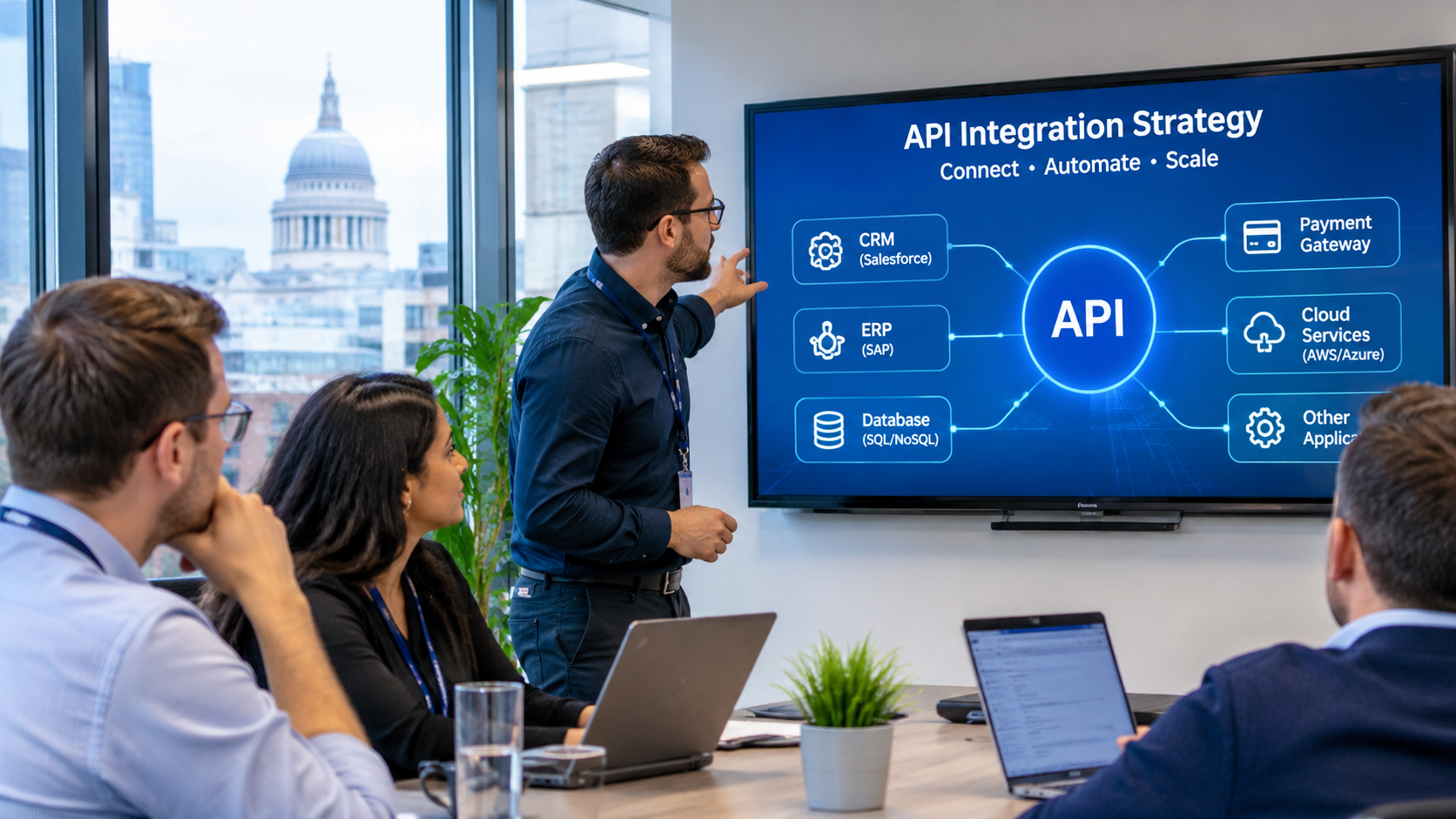
Image alt text: Business technology specialists planning API integration between CRM, ERP, finance and operational software systems.
Suggested placement: Immediately below the H1.
Suggested image concept: A real professional technology architecture workshop showing business and technical specialists reviewing a connected systems architecture on a large display.
Internal Linking Plan — 9 placements
Introduction — Industries: https://thenexteck.com/industries
Business technology strategy — Homepage: https://thenexteck.com/
CRM and ERP integration — Industries: https://thenexteck.com/industries
Architecture planning — Toolkit: https://thenexteck.com/toolkit
Integration security and governance — Homepage: https://thenexteck.com/
Industry applications — Industries: https://thenexteck.com/industries
Custom development — Homepage: https://thenexteck.com/
SME assessment — Toolkit: https://thenexteck.com/toolkit
Final CTA — Homepage: https://thenexteck.com/
SEO note: Meta keywords are included for CMS metadata, but Google does not use the meta keywords tag as a ranking signal. Prioritise useful content, search intent, technical SEO and relevant internal links.
CTA: Explore Nexteck's technology solutions and SME Strategy Toolkit to identify practical next steps for your organisation.