Business Dashboards That Help UK Leaders Make Better Decisions
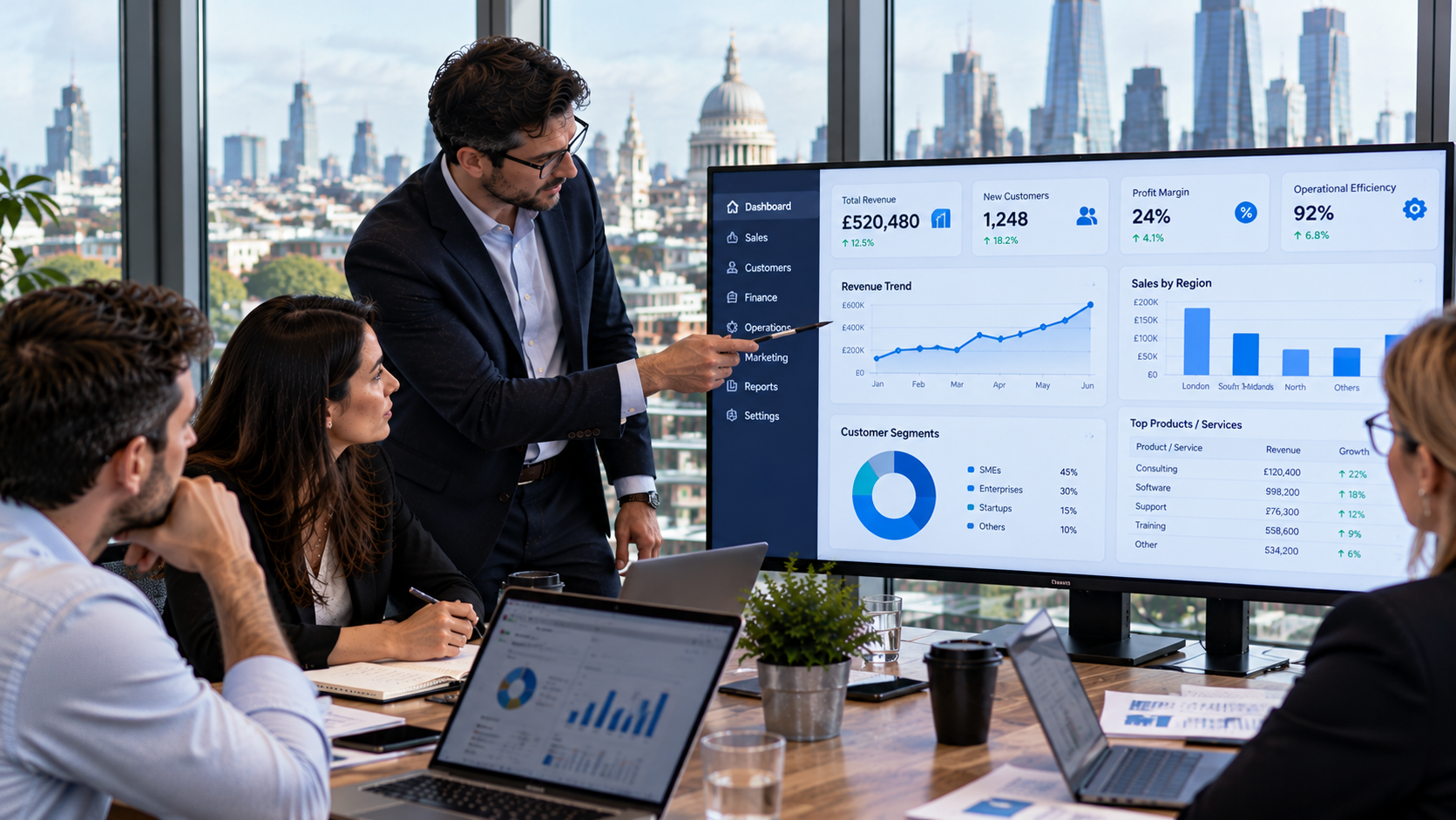
A business dashboard should support
decisions, not simply display numbers. Learn how UK SMEs can design useful KPI
dashboards around action, ownership and business outcomes.
Many companies have dashboards,
but fewer have dashboards that genuinely improve decision-making. A screen
filled with charts can look impressive while telling managers very little about
what needs attention. The value of a dashboard comes from connecting the right
metric to the right decision at the right time.
The first question should therefore be: who
is using the dashboard and what decision do they need to make? An executive may
need a small set of indicators covering revenue, margin, customer retention and
operational performance. An operations manager may need queue depth, service
levels and exceptions. A sales team may need pipeline movement and conversion.
Different roles require different signals.
Data
quality comes before design. If the underlying numbers are assembled
manually or definitions change between reports, a polished dashboard can create
false confidence. Before building visualisations, businesses should document
data sources, definitions, update frequency and ownership. Nexteck’s approach
combines data engineering with purpose-built dashboards so that reporting is
connected to operational reality.
The most useful dashboards also highlight
exceptions. Leaders rarely need to spend an hour every week reading every
metric. They need to know what changed, why it changed and what requires
attention. A good dashboard can therefore use thresholds, alerts and trend
information to direct management attention toward the areas where action is
most valuable.
Dashboards should also be connected to
accountability. If a KPI moves outside its target range, someone should know
who owns the next action. This is where KPI
governance becomes important. Nexteck describes a model where
targets and actuals across business functions are reviewed regularly, with
attention focused on red flags rather than producing reports for their own
sake.
Security and access matter as well.
Financial, customer and operational data should not automatically be visible to
everyone. Role-based access, secure authentication and appropriate monitoring
should be part of the dashboard architecture. NCSC guidance on identity and
access management is a useful reference when designing controls around systems
and data. For further context, see NCSC identity guidance.
A dashboard is most effective when it
becomes part of the operating rhythm. A weekly review should lead to actions,
and those actions should be tracked. Over time, this creates a feedback loop:
the business measures performance, identifies a problem, changes the process,
and then checks whether the change worked.
For
UK SMEs, dashboard design is therefore less about choosing between
visualisation tools and more about building a management system. The technology
matters, but the bigger question is whether the dashboard helps the
organisation see what is happening and respond before a small issue becomes an
expensive problem. For further context, see Nexteck
methodology.